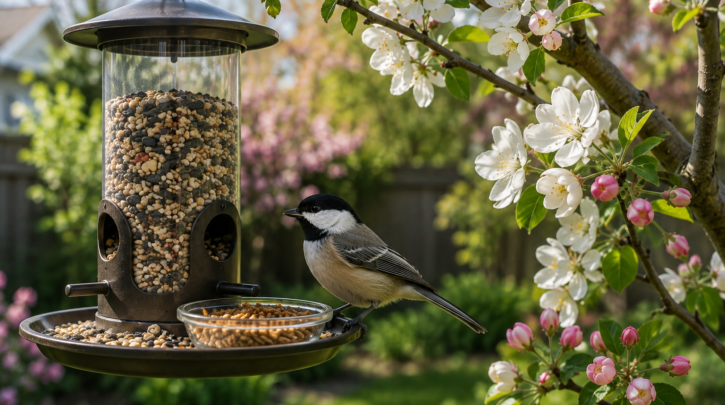

Spring brings a genuinely different set of demands on a feeding station as natural food starts returning and breeding season gets underway across nearly every bird species.
This site participates in affiliate programs. If you buy through a link on this page, we may earn a commission at no extra cost to you. Affiliate disclosure
A Natural Dip in Seed Consumption
As insects and other natural food sources become available again, it’s genuinely normal to see a modest drop in seed consumption compared to winter’s peak — this isn’t a sign anything has gone wrong, just birds having more natural options available again.
Rising Protein Demand
As breeding season begins, protein demand rises sharply for parents feeding nestlings, making this a particularly good season to consider offering mealworms, covered in our mealworm guide, alongside standard seed and suet.
Increased Overall Activity
Territorial and breeding behaviors genuinely ramp up in spring, often bringing noticeably more activity and vocal behavior around a feeding station than the quieter stretches of winter.
A Good Season for a Deep Clean
After winter’s heavy feeder traffic, spring is a reasonable time for a thorough top-to-bottom cleaning of every feeder in a station, covered in our cleaning guide, rather than the routine maintenance cleaning that carries a station through the rest of the year.
Rising Water Demand
As temperatures climb, water needs increase accordingly, and confirming a bath or water feature, covered in our bird bath guide, is clean and genuinely functional after winter matters more now than it did during the coldest months.
Spring isn’t simply a quieter version of winter feeding — rising protein demand, a natural dip in seed consumption, and a genuine uptick in overall activity all shift what a feeding station actually needs to provide.
A Season of Genuine Transition
Rather than expecting spring to look like a smaller version of winter, recognizing it as a genuinely distinct season with its own specific needs — protein, water, a deep clean — leads to a considerably more effective feeding approach than simply continuing winter’s routine unchanged.
Curious how summer builds on these spring changes? See our summer feeding guide for what comes next as temperatures continue rising.
A Season Worth Watching Closely
Few seasons bring this much genuine change to feeder activity in such a short window, making spring one of the more rewarding stretches of the year to pay close attention to what’s actually happening at a feeding station.
A camera feeder like the Birdfy Feeder makes that easier, recording and identifying each visitor so you don’t miss a short stopover.
A Reasonable Spring Checklist
- Deep-clean every feeder after winter’s heavy use
- Consider adding mealworms as breeding season protein demand rises
- Check bath and water feature function after any winter freeze damage
- Expect, and don’t worry about, a modest dip in seed consumption
- Watch for increased territorial activity and vocal behavior around the station
A Season of Renewed Attention
Spring genuinely rewards a host willing to actively reassess a feeding setup rather than simply continuing winter’s routine unchanged, since so many of the underlying conditions driving feeder need have shifted meaningfully in just a few weeks.
Setting Up for the Months Ahead
Getting spring’s adjustments right — the deep clean, the added protein, the water check — sets a feeding station up well for the demands summer will bring next.
A Season of Real Momentum
The energy of spring, both for birds and for hosts, tends to carry a feeding station through the rest of the year with genuine momentum, making it a genuinely good season to establish habits that persist well beyond these few transitional weeks.
Pay attention to what actually changes in your own specific yard this spring, rather than assuming every season looks the same everywhere, and the adjustments covered here will genuinely make more sense in context.
No two yards behave identically, and the specific timing of these shifts will always vary somewhat by region, climate, and which species happen to actually be present locally.
Treat these guidelines as a genuinely reasonable starting point, then let your own direct observation refine them further, season after season, year after year.
That willingness to adjust based on what you actually observe, more than any specific rule covered here, is genuinely what separates a thoughtful, attentive feeding station from a purely mechanical, unresponsive one over the course of an entire year.
Carry that mindset into summer, and the transition covered in the next guide will feel like a natural, genuine continuation of the exact same practical approach rather than a completely and genuinely separate, unrelated topic entirely and quite completely on its very own separate, distinctly genuine merits alone entirely, right from the very start to the very finish of the whole entire season.