
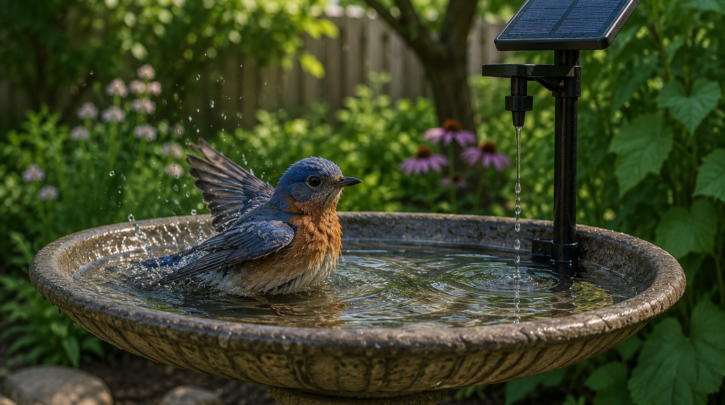

Water genuinely matters just as much as food for backyard birds, and a well-chosen bath or water feature rounds out a feeding station in a way seed and suet alone never fully can.
What to Look For
- A basin with reasonable depth at the center but a gradually sloping edge, accommodating both larger bathing birds and smaller birds preferring shallower water
- Sturdy, stable construction that won’t tip under vigorous bathing activity
- Material that resists algae buildup and is genuinely easy to clean regularly
- Placement with nearby cover for a quick escape route while wet and less able to fly effectively
Our top pick, the Birdfy Bath Pro, adds a solar-powered fountain for movement and a two-lens camera that records every visit.
Pedestal Baths
A raised pedestal design offers good visibility and somewhat reduced ground-level predator exposure compared to a bath sitting directly on the ground, making it a popular general choice across most yards.
Ground and Deck-Mounted Options
For yards without a good spot for a full pedestal bath, deck-mounted and ground-level options offer a lower-commitment alternative, though ground baths specifically benefit from clear surrounding sightlines given the added predator exposure at that level.
Heated Baths for Winter
In regions where birds remain resident through freezing conditions, a heated bath keeps water accessible during exactly the stretch of the year natural water sources are hardest to find.
Solar-Powered Options
Solar-powered fountain or dripper attachments add moving water, which genuinely attracts more attention from passing birds than still water alone, without requiring a direct electrical connection near the bath.
Moving water draws noticeably more attention from passing birds than still water does — even a small solar-powered dripper can meaningfully increase how quickly a bath gets discovered and used.
Maintenance Matters as Much as Design
Regardless of style, regular cleaning is essential — stagnant, dirty water creates the same disease transmission risk covered in our disease and hygiene guide, particularly for trichomonosis, which spreads readily through shared water sources.
Want to round out a complete feeding station? See our multi-feeder station guide for how a bath fits alongside feeders.
A Genuinely High-Value Addition
For a yard already running feeders, adding a well-maintained water feature is often the single most impactful next step, drawing species and behavior no feeder alone can offer.
Sizing a Bath Correctly
A basin too small limits how many birds can use it comfortably at once, while an oversized bath can be harder to keep clean and may require more water to keep genuinely fresh between cleanings, making moderate, proportional sizing a reasonable general target.
Winter-Specific Considerations
Beyond heated baths, positioning any water feature somewhere it receives at least some direct winter sun helps reduce how quickly water refreezes between refills in regions with only occasional hard freezes.
A Feature Worth the Modest Investment
Compared to many other purchases covered across this site, a quality bird bath represents a genuinely modest investment relative to how much additional activity and species diversity it can bring to an already-established feeding station.
A Final Word
Start with a basic, well-placed bath before investing in solar or heated upgrades, and let actual observed use guide whether those additions are worth adding. A bath that gets used regularly is always a better investment than a more elaborate one sitting empty in the wrong spot.
Watch where birds already choose to drink or bathe naturally in your yard, and place a new bath as close to that existing pattern as possible — that kind of observation consistently outperforms any general placement rule. A little patience at the start pays off with a water feature that genuinely gets used.