
Window collisions represent one of the largest human-caused sources of bird mortality in the United States, with widely cited research estimates running into the hundreds of millions of birds annually. Understanding why it happens makes prevention considerably more effective than guesswork.
Why Birds Fly Into Windows
Birds don’t perceive glass as a solid barrier the way humans do. A window either reflects sky and surrounding habitat convincingly enough to look like open space, or offers a clear view straight through to habitat on the other side, both creating a genuine visual illusion that there’s nowhere solid actually there.
What Genuinely Works
Exterior Decals and Film With Dense Spacing
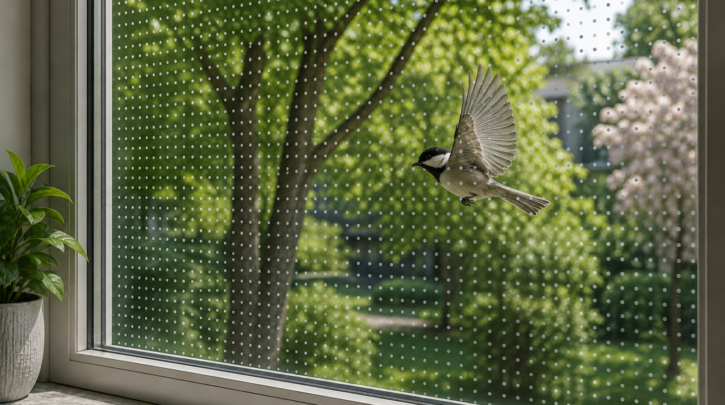
Effective decal or film treatments need patterns spaced no more than about two inches apart — a widely cited spacing guideline from bird conservation research — since birds will readily attempt to fly through gaps wider than that, treating each gap as its own open space rather than registering the whole window as solid.
External Screens and One-Way Film
Physical screens mounted outside the glass, or specialized one-way transparent film, both break up the reflective and see-through qualities that create the collision illusion in the first place.
Feeder Placement Itself
As covered in our placement guide, positioning feeders very close to windows or genuinely far away avoids the dangerous middle-distance zone where birds are moving fast enough to be seriously hurt.
What Doesn’t Work Well
A single hawk silhouette sticker placed in one corner of a large window does almost nothing — birds don’t generalize danger from one small decal across an entire pane of glass, a genuinely common and persistent misconception worth correcting directly.
A single hawk decal in the corner of a window does almost nothing to prevent collisions — birds simply don’t generalize a warning from one small sticker across the rest of the glass.
Interior Treatments Are Considerably Less Effective
Decals or film applied to the inside of a window address only the see-through effect and do nothing about outward reflection off the exterior glass surface, which is often the more significant cause of collisions in the first place. Exterior treatments genuinely outperform interior ones.
If a Bird Strikes Your Window Anyway
- Assess for obvious injury before approaching or handling the bird
- If stunned but not obviously injured, place it in a dark, ventilated box and keep it away from pets and noise
- Allow a genuine rest period, often 30 minutes to an hour, before attempting release
- If injury appears serious or the bird doesn’t recover after resting, contact a local wildlife rehabilitator rather than attempting further care yourself
A Problem Worth Taking Seriously
Because window strikes represent such a genuinely large share of overall bird mortality, addressing even one or two high-risk windows with proper exterior treatment can meaningfully reduce risk for every bird visiting a feeding station nearby.
Considering feeder placement as part of your prevention strategy? See our full placement guide for the complete picture.
A Genuinely Solvable Problem
Unlike some conservation issues that feel too large for an individual household to meaningfully affect, window strike prevention is a genuinely direct, actionable choice available to nearly anyone with windows and a feeder.
Identifying High-Risk Windows
Large picture windows, windows positioned across from each other creating a see-through effect, and windows reflecting nearby trees or sky particularly convincingly are all genuinely higher-risk than smaller or less reflective windows, and prioritizing treatment on these specific windows first offers the best return on effort.
A Simple Way to Spot Risk
Standing outside and looking at a window from a bird’s likely approach angle, checking for strong reflections or a clear view straight through the house, is a genuinely useful way to identify which windows deserve priority treatment.
A Growing Awareness
Window strike prevention has received considerably more attention in recent years as research documenting the true scale of the problem has become more widely known, leading to a growing range of purpose-built products specifically designed to address it effectively.
A Final Thought
Given how large this issue is at a population level, treating even a single high-risk window represents a meaningful contribution well beyond what the small effort involved might suggest.
Start with just one or two of your highest-risk windows, and expand treatment from there once you see how effectively it works in practice.