
No single trick fully excludes squirrels from a bird feeder — but layering several genuinely effective strategies together gets a determined host remarkably close to that goal.
Physical Barriers
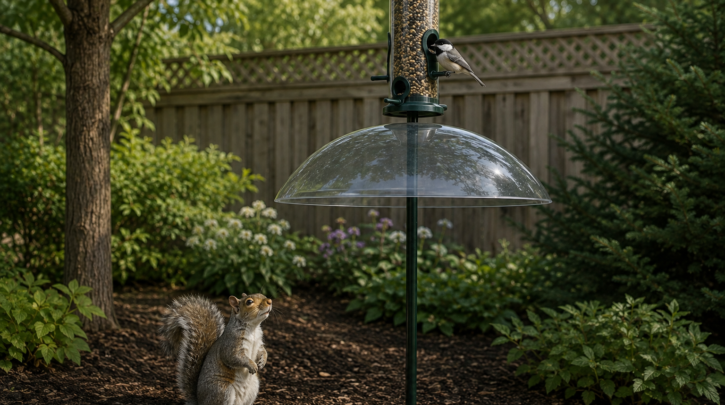
A dome or cylindrical baffle mounted below a pole-mounted feeder blocks the direct climbing route squirrels rely on most often, covered in more detail in our height and safety guide.
Launch Point Distance
Squirrels can jump remarkably far, so keeping a feeder at least roughly ten feet from trees, fences, or structures a squirrel could use as a launch point genuinely matters as much as any baffle on the pole itself.
Hanging vs. Pole-Mounted
A feeder hung from a thin wire or cable can be genuinely harder for a squirrel to balance on than a solidly mounted pole feeder lacking a baffle, since the instability itself becomes a meaningful deterrent.
Feeder Design
Weight-activated and caged exclusion feeders, covered in full in our exclusion feeder guide, directly address squirrel access through mechanism rather than placement alone. Sturdy metal construction, covered in our materials guide, resists chewing considerably better than wood or standard plastic.
Food-Based Deterrents
Safflower seed, covered in our seed comparison guide, genuinely discourages many squirrels given its bitter taste, while several birds continue eating it without issue.
Capsaicin-Treated Products
Some suet and seed products are treated with capsaicin, the compound responsible for pepper heat. Birds genuinely lack the same capsaicin receptor sensitivity mammals have, so the treatment doesn’t bother visiting birds at all while still deterring squirrels and other mammals from the same food.
Birds and mammals process capsaicin completely differently — a pepper-treated suet cake genuinely doesn’t register as spicy to a chickadee, even though it reliably deters the squirrel trying to steal the same food.
What Doesn’t Work Well
Most sprays and scent-based deterrents show limited, inconsistent effectiveness at best, and simply relocating a feeder without addressing the underlying access points just shifts the same problem to a new location rather than genuinely solving it.
A Pragmatic Alternative
Some hosts skip the exclusion battle entirely and instead offer a separate, dedicated squirrel feeding station well away from the main bird feeders, satisfying squirrel interest without letting it interfere with feeder access at all.
Ready to combine several of these strategies at once? See our multi-feeder station guide for how squirrel management fits into a complete station layout.
Realistic Expectations
The genuine goal here is meaningful reduction, not total elimination — layering physical barriers, smart placement, feeder design, and food choice together gets remarkably close, but an occasional determined squirrel is a normal part of hosting birds outdoors.
Testing What Works in Your Specific Yard
Local squirrel populations vary in persistence and cleverness, so a strategy that works perfectly for one yard may need adjustment in another — treating this as an evolving approach rather than a single fixed solution tends to produce better long-term results.
A Note on Squirrel Behavior
Squirrels are genuinely intelligent, persistent problem-solvers, and a strategy that works immediately may eventually need reinforcement as individual squirrels learn and adapt to a given feeder’s specific defenses over time.
A Combination Worth Committing To
Rather than searching for one perfect solution, accepting that squirrel management genuinely works best as an ongoing combination of strategies tends to produce more consistent, sustainable results than chasing a single silver-bullet fix.
A Final Thought
Even hosts who eventually settle on a dedicated separate squirrel station generally still benefit from basic exclusion measures on the main feeders, since squirrel interest rarely disappears just because an alternative exists nearby.
Give any new strategy a genuine multi-week trial before judging it, and expect the right combination for your specific yard to take a season or two of adjustment to find. Patience, more than any single product, is what separates a successful long-term approach from a frustrating one.