
Feeder height and a few specific design choices genuinely affect how vulnerable visiting birds are to predators — a detail easy to overlook when placement decisions focus mainly on convenience or viewing angle.
General Height Guidelines
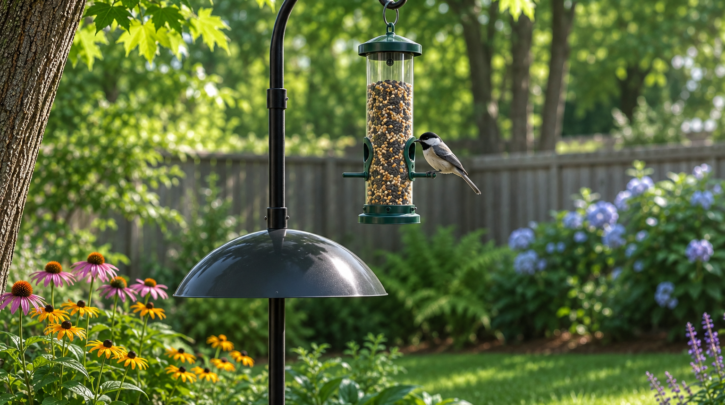
Most hanging feeders work well at roughly five to six feet off the ground, a height that balances easy bird access against making the feeder considerably harder for ground-based predators, including cats, to reach with a direct jump.
Pole Baffles
A dome or cylindrical baffle mounted on a feeder pole below the feeding area blocks squirrels and many ground predators from simply climbing the pole directly, a widely used and genuinely effective addition to any pole-mounted feeder setup.
The Cat Problem
Outdoor and feral cats are a well-documented, major source of backyard bird mortality, with commonly cited estimates placing the toll in the billions of birds annually across the United States — a scale of impact comparable to the window strike issue covered in our window strike guide.
Reducing Ambush Success Around a Feeder
Avoiding dense, low cover immediately adjacent to a feeder, while still keeping some retreat cover within reasonable flight distance as covered in our placement guide, reduces the concealment a stalking cat would otherwise rely on.
Cat Collars and Bells
Bell collars on pet cats show mixed but real evidence of reducing successful predation somewhat, though they don’t eliminate the risk entirely — some cats learn to move in ways that minimize bell noise, and a still, crouched ambush doesn’t require much movement to trigger a successful strike.
The Most Effective Solution
Keeping pet cats indoors, or supervised in a secure outdoor enclosure, remains the single most effective way to eliminate a specific cat’s impact on local bird populations, a choice genuinely left to individual owners but worth presenting alongside the actual statistics involved.
Outdoor cats are a genuinely major, well-documented source of backyard bird mortality — on a scale comparable to window strikes — making feeder placement and cat management two of the most impactful safety decisions a host can actually make.
Hawks and Other Avian Predators
A hawk hunting near a feeder is a natural occurrence rather than a sign anything has gone wrong — feeders concentrate small bird activity, which naturally attracts the predators that rely on exactly that kind of concentration. This is a normal part of the local food web rather than something to feel responsible for causing.
What to Do About a Persistent Hawk
If a specific hawk is repeatedly hunting successfully at one feeder, temporarily removing the feeder for several days can encourage it to move on to hunting elsewhere, though this isn’t strictly necessary and many hosts simply accept occasional predation as part of hosting a genuinely active feeding station.
Want to review full placement principles alongside these safety considerations? See our placement guide for the complete picture.
A Reasonable Overall Approach
Combining sensible feeder height, a pole baffle where relevant, thoughtful cover placement, and responsible pet cat management addresses the great majority of predator risk a typical backyard feeding station actually faces.
Weighing Risk Realistically
No feeding station can eliminate predator risk entirely, and that’s a genuinely normal part of hosting wildlife rather than a sign of a poorly designed setup — the goal is meaningfully reducing avoidable risk, not achieving an impossible zero.
A Final Word on Cats Specifically
Given how significant outdoor cat predation genuinely is at a population level, even modest individual choices, like keeping a single pet cat indoors, contribute meaningfully to the broader picture beyond just one household’s own backyard.
Predator Awareness as Part of Responsible Hosting
Understanding these risks isn’t meant to discourage feeding birds at all — it simply makes for a more informed, genuinely more effective approach to hosting wildlife responsibly.
A Final Thought on Balance
Predator activity — whether from a cat, a hawk, or a squirrel testing an exclusion feeder — is ultimately part of what makes an active feeding station a real slice of the local ecosystem rather than an artificially sanitized one.
The goal was never a predator-free yard, only a thoughtful one that reduces avoidable risk while still welcoming local wildlife as it actually exists. That balance, more than any single rule covered here, is what responsible feeder hosting comes down to.