
Feeder placement genuinely affects window strike risk, predator vulnerability, and how comfortably birds can actually feed — far more than most first-time hosts realize when simply choosing whatever spot looks convenient.
Distance From Windows: The Counterintuitive Rule
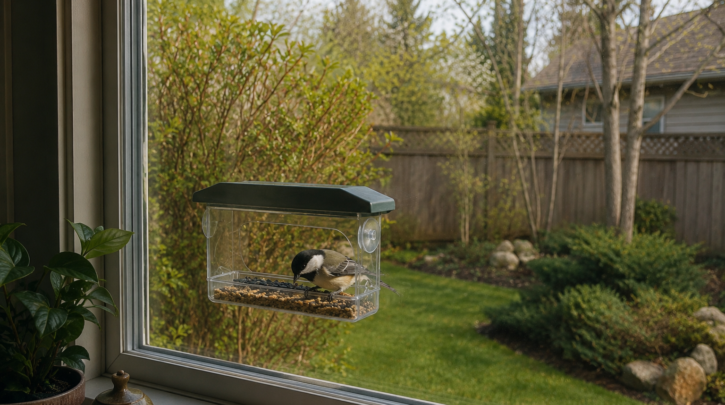
Placing a feeder either very close to a window, within about three feet, or genuinely far away, beyond thirty feet, is safer than the middle distance in between. A bird feeding immediately next to the glass can’t build up enough flight speed to injure itself in a collision, while a bird thirty feet or more away has enough visual separation and reaction time to register the glass as an obstacle. The danger zone sits in between, where a bird is already at meaningful flight speed but still close enough to be fooled by a reflection.
Why This Matters So Much
This isn’t a minor detail — window collisions are a genuinely massive source of bird mortality, covered in full in our window strike guide. Placement alone won’t solve the problem entirely, but it’s one of the simplest, lowest-cost steps available.
Distance From Cover
A feeder needs nearby cover — shrubs or trees — that visiting birds can retreat to quickly if a predator appears, but placing a feeder too close to dense cover gives an ambushing cat or other predator a concealed staging point. A rough guideline of ten to twelve feet from dense cover balances quick escape access against ambush risk, covered further in our predator safety guide.
Wind and Weather Exposure
A feeder sheltered from prevailing wind reduces seed scatter and gives birds a more comfortable place to actually feed, particularly during storms or persistent wind. Some morning sun is generally welcome, helping dry overnight dew, but full, unbroken afternoon sun through summer can accelerate seed spoilage and heat up metal feeders uncomfortably.
Visibility for You, the Host
Placing a feeder within easy view of a favorite window matters for actually enjoying the birds you’re attracting, but this consideration should work alongside, not against, the window-distance safety guidance above — a feeder positioned very close to the viewing window itself, rather than at a mid-range distance, satisfies both goals at once.
Ground and Platform Feeders Need Different Placement
Ground-feeding species using platform feeders benefit from more open surrounding space than hanging feeders do, since ground-level feeding leaves birds more exposed to ambush predators already lurking in nearby cover.
The safest feeder placement is often the most counterintuitive one — right up against the window, or far enough away that the window barely factors in, rather than somewhere comfortably in between.
Putting It All Together
- Close to a window (under 3 feet) or genuinely far (over 30 feet), never in between
- Roughly 10-12 feet from dense cover for quick escape without concealing predators
- Sheltered from prevailing wind where possible
- Positioned to avoid unbroken afternoon summer sun
- Visible from inside the house without compromising the window-distance rule
Running more than one feeder? See our multi-feeder station guide for how to apply these placement principles across a full setup.
A Worthwhile Investment of Time
Getting placement right before installing a feeder saves considerably more trouble than relocating one later, since birds that have already learned a feeding location can take time to rediscover it somewhere new.
Adjusting Placement Over Time
Placement isn’t necessarily a one-time decision — seasonal changes in sun angle, vegetation growth, or new predator activity can all justify revisiting an existing setup even after it’s been working well for some time.
Signs a Feeder Might Need Relocating
- Repeated window strikes near the current location
- Consistent predator success at the site
- Seed spoiling unusually fast due to sun or moisture exposure
- Persistent low visitor traffic despite otherwise good food and feeder choice
A Foundation for Everything Else
Every other decision covered across this site — feeder type, food choice, station design — ultimately depends on getting this foundational placement decision right first, making it genuinely worth the extra thought before anything goes into the ground.
A Final Word on Getting Started
Even an imperfect first placement, corrected over time as you learn what actually works in your specific yard, beats endless deliberation before ever putting up a feeder at all — these principles are meant to guide a reasonable starting decision, not to demand complete, immediate perfection on the very first genuine attempt ever made.
Watch how birds actually respond over the first few weeks, and adjust from there — that real-world feedback will always tell you more than any general guideline ever fully can.