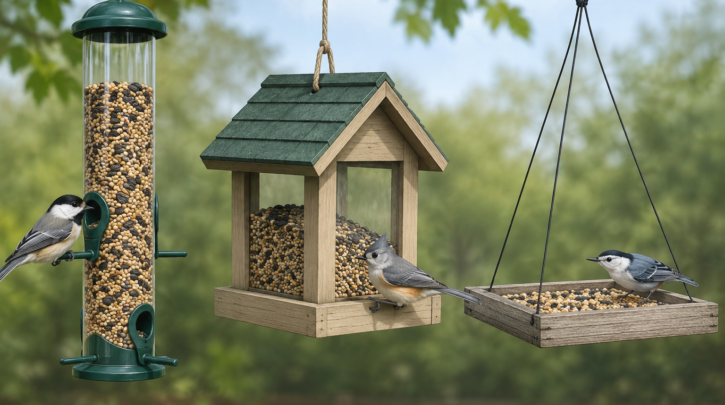

Almost every backyard feeder on the market is some variation on three basic designs. Understanding what each one actually does well makes choosing between them considerably easier than comparing individual products feature by feature.
Tube Feeders
A cylindrical tube with multiple feeding ports, typically holding a single seed type such as black oil sunflower or nyjer. Tube feeders excel at attracting smaller songbirds — finches, chickadees, titmice — while keeping seed genuinely protected from rain inside the enclosed tube.
Where Tube Feeders Fall Short
Ports are often too small for larger birds to use comfortably, and capacity is generally moderate compared to a hopper. Cleaning requires disassembly, which some designs make easier than others.
Hopper Feeders
A house-shaped design with a gravity-fed reservoir dispensing seed into a tray below. Hopper feeders generally hold more seed than a tube, accommodate a wider range of species including larger birds, and the roof provides genuine weather protection over the feeding tray.
Where Hopper Feeders Fall Short
Because the feeding tray is more open than a tube’s ports, hopper feeders can attract larger or more aggressive species alongside the smaller birds you may actually be trying to feed, and the open tray is somewhat more exposed to wind-driven rain than a fully enclosed tube.
Platform Feeders
The simplest design: a flat, open surface with no walls or roof at all. Platform feeders accommodate virtually every species, including ground-feeding birds and larger visitors that struggle with tube or hopper designs, and they’re generally the easiest type to clean given the completely open surface.
Where Platform Feeders Fall Short
Seed sits fully exposed to rain and ground contact, which means platform feeders carry the highest disease and mold risk of the three designs if not cleaned on a genuinely regular schedule, covered in our cleaning guide.
There’s no single best feeder type — a tube feeder protects seed, a hopper balances capacity and reach, and a platform feeder welcomes the widest range of species at the cost of needing the most frequent cleaning.
A Quick Comparison
- Best seed protection from weather: tube feeder
- Best capacity-to-footprint ratio: hopper feeder
- Best species range, including ground feeders: platform feeder
- Easiest to clean thoroughly: platform feeder
- Best for limiting access to smaller songbirds specifically: tube feeder
Which Should You Actually Buy First?
For a genuinely universal first feeder, a hopper feeder offers the best balance of capacity, species range, and weather protection. Add a tube feeder if you specifically want to favor smaller finches and chickadees, or a platform feeder if you want to welcome ground-feeding species like doves and juncos that struggle with either enclosed design.
Dealing with squirrels or larger birds dominating your feeder? See our caged and selective feeder guide for designs built specifically to exclude them.
Running More Than One Type
Most experienced hosts eventually run more than one feeder type simultaneously, since each design genuinely serves a different purpose rather than one simply being an upgrade over another — see our multi-feeder station guide for how to combine them effectively.
Capacity and Refill Frequency
Hopper feeders generally offer the best capacity-to-footprint ratio, meaning fewer refill trips for a given amount of seed, while tube feeders trade some capacity for better weather protection and platform feeders trade capacity almost entirely for accessibility and ease of cleaning.
Price Considerations
Platform feeders are generally the least expensive design given their structural simplicity, while tube and hopper feeders vary more widely in price depending on material quality and added features like built-in squirrel exclusion.
A Reasonable Starting Point for Most Yards
If forced to choose only one feeder type to start with, a mid-sized hopper feeder genuinely balances capacity, species range, and weather protection better than either alternative on its own, making it a sensible default before expanding into a multi-feeder setup.
A Final Word on Choosing Between Designs
Whether a tube, hopper, or platform feeder actually performs best for you comes down largely to which species you’re hoping to attract and how much squirrel or larger-bird pressure your yard genuinely faces — all three designs work well once matched to the right situation and the specific birds you are actually hoping to see.
Final Thoughts
Rather than treating this as a single purchase decision, think of it as choosing a starting point — most successful backyard setups grow into a small collection of feeder types over time, each earning its place for a genuinely different reason, one thoughtful addition at a time as real needs actually become clear.